Hi all - I was hoping to get some tips for information sources when researching horticultural matters, garden design, etc.
I find that I have to sift through a lot of low-quality, seemingly AI-generated articles. I’d much rather support the actual master gardeners, extension services and companies that are doing the work to put together good information.
I find similar slop when looking at food and cooking websites, so I find myself going to places I know and trust like NYT Cooking and King Arthur.
So, I’d be grateful for resources of all kinds that are known and trusted to have good information. For example, the Royal Horticultural Society (RHS) website is pretty good. Although they are commercial, I also look at West Coast Seeds and Proven Winners for planting and care info.
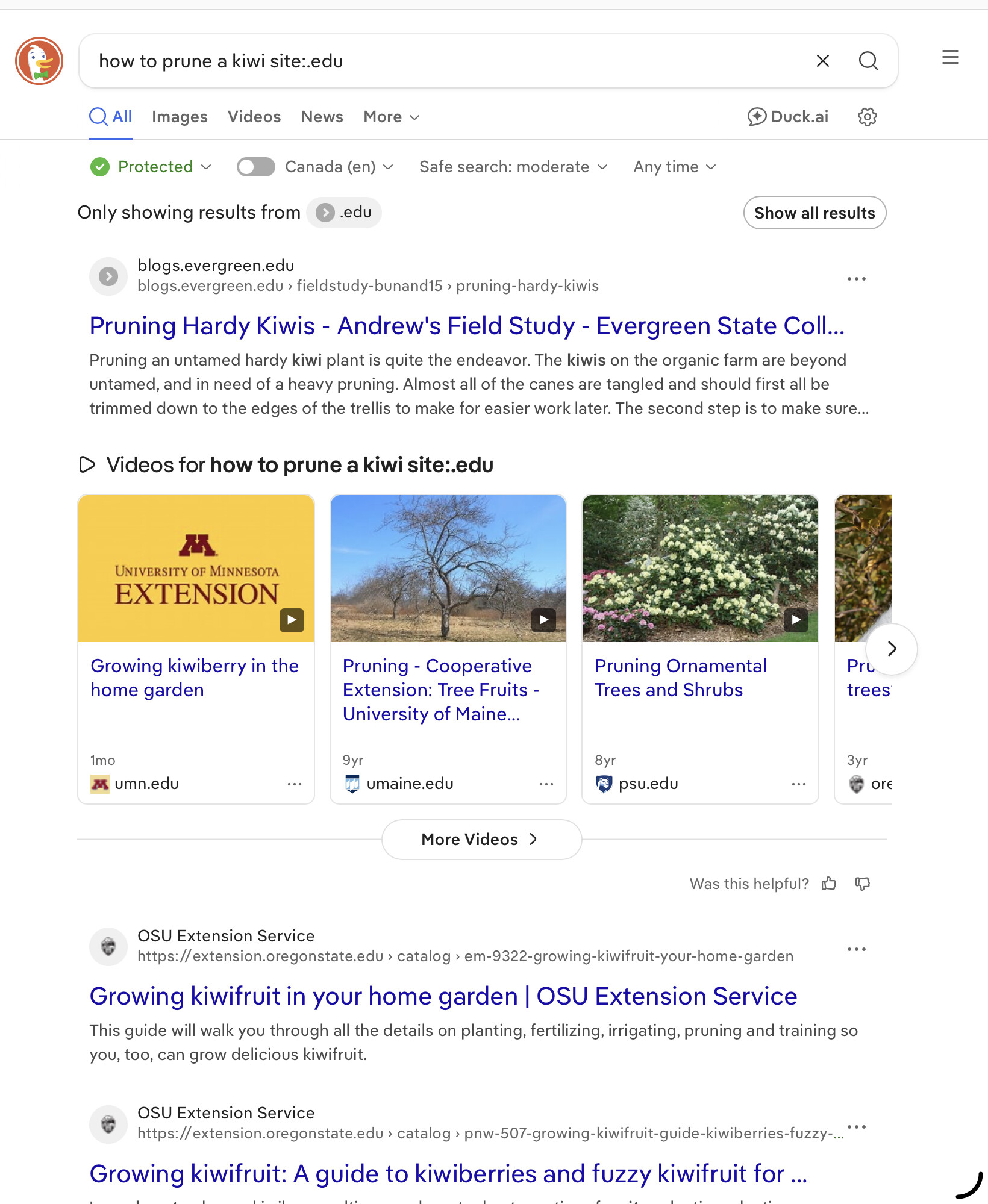
This is so true! I find that educational websites with the extension ‘.edu’ are quite reliable. They are often university extensions and are really helpful. You can perform your searches to just return results from these institutions by using the following syntax in your search:
if you want to search for ‘how to prune a kiwi’, type:
how to prune a kiwi site:.edu
Screenshot below. This works using DuckDuckGo and Google search engines so it will probably work on most search engines.
I would suggest Linda Gilkeson’s website. Maybe not so much for design, but for information on growing, insects, fungi, diseases and pest controls for OUR area (she is on Salt Spring), I don’t think she can be beat. She also has a list of what to plant when in her blogs. She has also published a number of books, the one on pests is my go to for things eating up my garden.https://www.lindagilkeson.ca/
I found the following garden design site, by a real person, to be very helpful. She has both free and for -purchase resources. Although she is based in the US, her approach is applicable to any site and climate conditions.
For choosing plants that work well in our climate see the following:
The Capital Regional District (Victoria, BC) has resources about natural gardening:
If you want more detailed information about a particular plant, as Lorna pointed out, the American university extension services are good. I especially like:
If you are interested in providing bird habitat, see this site:
To avoid growing invasive plants, this site is useful.
Many thanks to Milner Gardens & Woodland’s Gardening Advice line (a partnership between Vancouver Island University’s Milner Gardens & Woodland and the Vancouver Island Master Gardeners Association) for the following response:
Hello,
Thanks for your question about legitimate resources for gardening question. The rule of thumb is any science-based source is what you are looking for. Usually, websites will have the .edu or .ca or .org suffixes on their web address, making them fairly easy to identify. Websites ending in .com are businesses of some sort or personal blogs which in turn means they are making money off their web traffic. This doesn’t mean their info is bad necessarily, but they don’t usually cite their sources so you don’t know if it is science-based or not. Personal blogs in particular can have a lot of unresearched anecdotal info that probably shouldn’t be trusted without verifying. These kinds of sites can be an okay place to start a search but you should always do further research to determine the legitimacy of the information.
Another thing to be aware of is that while there are tons of science-based websites, be careful about looking at those outside of our ecosystem, especially for info on plants that will do well here. Any science-based website in the Pacific Northwest will be fine. You can look outside the Pacific Northwest for simple things like plant ID. For example, the Missouri Botanical Gardens is an amazing source of info on thousands of plants from many ecosystems in North America. It’s very useful for plant ID or just a straight-up description if that’s what you are looking for.
The Vancouver Island Master Gardeners website maintains an extensive list of science-based website and other resources at External Links - Vancouver Island Master Gardeners Check it out along with lots of other resources for gardeners on our website!