It is that time of the year when we all have been winterizing our gardens. As we were working on our garden, I paused to consider two plants that have a lineage longer than humans! So, what do we have in our garden that is ancient? The two plants I am talking about are at both ends of the “love-hate” spectrum of garden plants – one being a delightful gigantic display, and the other being an annoying weed that we cannot get rid of because of its tenacity for survival! As many of our friends have said, consoling us about the one, “we need to learn to love it”! And I guess we do, because it certainly is not going anywhere. Also, it has been around a lot longer than we have, so perhaps we need to acknowledge that and learn to appreciate it.
Let us deal with the worst first. The bottom end plant is the “delightful” – this is the ”love”, field horsetail (Equisetum arvense). It is endemic in our garden, and seems to be everywhere. It is one of the most primitive living plant families in the world. Dating back to the Carboniferous Period (354–290 million years ago), the ancestors of horsetail were tree sized and dominated the landscape, ultimately transforming into coal deposits found today. A perennial relative of ferns, Equisetum is the only living genus in the Equisetaceae family. It has many common names including scouring rush, horsetail fern, meadow-pine, pine-grass, foxtail-rush, bottle-brush, horsepipes, snake-grass, and cornfield horsetail. (https://www.canr.msu.edu/resources/field-horsetail-a-plant-as-old-as-time).
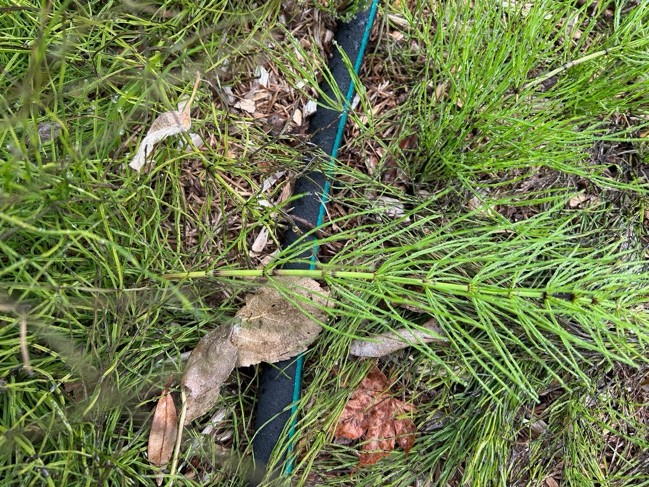
What makes this species enduring, and perhaps endearing – more of the “love”, is that its root system is deep, penetrating 6 to 10 feet. Many gardeners have used the green tops as fertilizer, as the plant brings deep nutrients to its green tops. Put the tops in a container filled with water and make a horsetail tea, then water/fertilize your plants. Like any “garden tea”, it will provide your plants with a lot of nutrients every time you water with it.
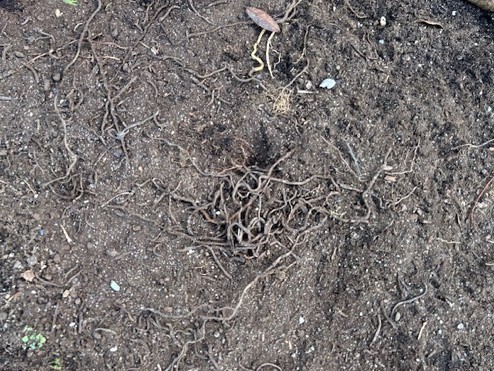
It is not so easy to get rid of this plant, as its roots are enduring. We have laid pond liner – essentially rubber mats, on the ground for several years. When we lifted them, the horsetail roots are all over the surface of the ground (as you can see in this picture) and still viable!
Our strategy for living with them is to prune the green tops down during the summer, as removing the nutrient source for the plant (photosynthesis) will weaken it. Eventually (think several years), they stop growing in those places. But, once you dig the ground over, they come back, because you have chopped up their roots and the stimulation causes them to grow from those root bits. (https://milnergardens.viu.ca/how-do-i-get-rid-horsetails).
I have to say, an incredible survival strategy! So, we live with them, and continue to learn to “love them”!